


Category : Uncategorized
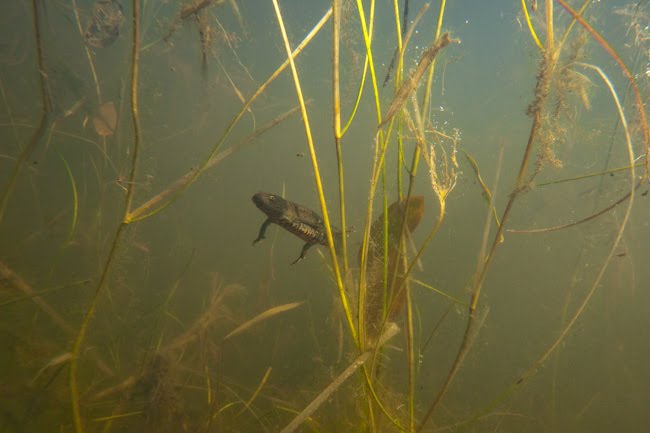
Bijna alle foto’s van salamanders zijn gemaakt met behulp van aquaria en niet voor niets. Het valt niet mee om bijvoorbeeld een Kamsalamander in een poel te zien te krijgen, laat staan te fotograferen. Dus vangen veel fotografen een exemplaar en houden het (soms voor langere tijd) in een aquarium. Ik heb ook dergelijke foto’s gemaakt, maar ik was eigenlijk nooit echt tevreden met het resultaat. Je ziet altijd dat het een onechte foto is, het licht, het water, het ziet er toch niet natuurlijk uit. Ik heb mezelf tot doel gesteld om Kamsalamanders in hun natuurlijke voortplantingswater te fotograferen. In Drenthe had ik een heldere plas gevonden, waar ik wist dat de soort voorkwam. Ik gebruikte een onderwaterzak en installeerde een krachtige draadloze afstandsbediening die ook onder water bleek te functioneren! Wel eerste de boel verzwaren anders ging het drijven. Vier uur lang heb ik onbeweeglijk met mijn waadbroek in de plas gestaan…….maar het is gelukt! Ik ga deze methode nog verder perfectioneren en hoop op nog meer van dit soort momenten.
Groet, Niels
Bezoek mijn website of Reageer via e-mail
Nearly all photos of newts are made using aquaria, and that has a reason. It is quite difficult to spot a, for example, Northern Crested Newt in a pool, let alone photograph it. So most photographers catch the animal and keep it in an aquarium. I have also made such photos, I was however never really satisfied with the result. One can always see that it is unreal, the light, the water, it just doesn’t look natural. I have set a goal to photograph Northern Crested Newts in their natural reproduction habitat. In Drenthe I found a clear pool, where I knew the species occurred. I used an underwaterpouch en installed a powerful wireless remote trigger that even functioned under water! I had to weight the stuff to keep it from floating. For four hours I was standing in the pool in my wading suit …..but I succeeded! I am going to refine this method and I hope to enjoy more moments like these.
Cheers, Niels
Visit my website or Respond through e-mail
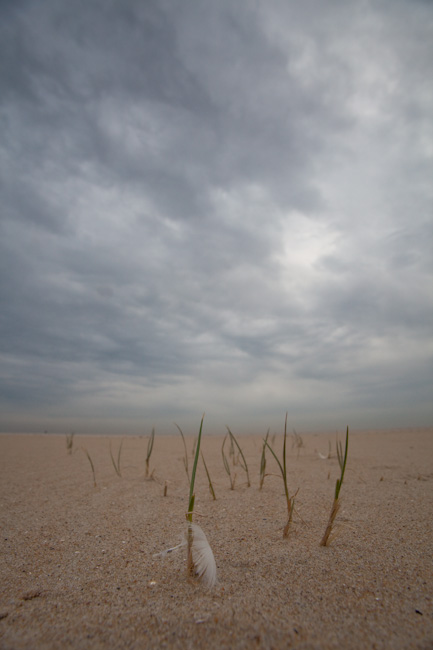
Soms kan een foto een verhaal vertellen. Soms is het verhaal achter een foto te complex om in één beeld te vertalen. Het verhaal achter deze foto is fascinerend. Het gras op de foto is Biestarwegras. Het is de enige plant die kan groeien op zandplaten aan de kust. Hij is extreem zouttolerant en vormt de basis voor duinvorming. Victor Westhoff, vegetatiekundige en natuurbeschermer, heeft ooit gezegd dat Nederland zonder dit plantje niet had bestaan, althans het lage deel van ons land. Of hij daarin gelijk heeft weet ik niet, maar er zit een kern van waarheid in. Op de foto heb ik het standvastige karakter van Biestarwegras verbeeldt door vanuit een laag standpunt te fotograferen, waardoor de nietige grasstengels groter worden en bovendien de donkere lucht als symbool van de elementen boven de planten hangt.
Groet, Niels
Bezoek mijn website of Reageer via e-mail
Sometimes a photo can tell a story. Sometimes the story behind a photo can be too complex to convey through a single image. The story behind this photo is fascinating. The grass on this photo is Sand couch. It is the only species that can grow at coastal sandflats. It is extremely salt tolerant and is responsible for the formation of dunes. Victor Westhoff, vegetation scientist and conservationist, once said that the Netherlands wouldn’t have existed without this little plant, well at least the low parts of the country. He might not be completely right, but there is some truth in it. In this photo I have captured the robust character of Sand couch by taking a low angle, enlarging the stems and also emphasizing the dark sky as a symbol for the elements.
Cheers, Niels
Visit my website or Respond through e-mail